
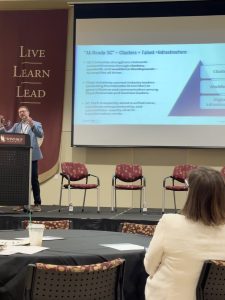
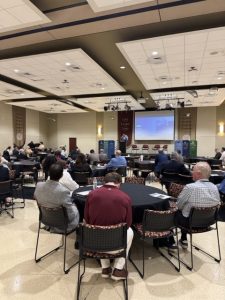
Most organizations are moving quickly to use AI, but many haven’t built the systems behind the scenes to support it. That gap shaped Brad Alexander’s session at the SC Competes Spring Summit, where he focused less on tools and more on what it takes to run AI reliably inside a business, and why South Carolina is well positioned to do it. Alexander, Vice President and CTO of DartPoints data centers, opened with a clear point: AI is no longer experimental. It is becoming part of everyday operations across industries. The real challenge now is not choosing tools, but building systems that produce consistent results.
Start With Outcomes, Not Tools
Alexander pushed back on the growing tendency to treat AI like a checklist.
“AI isn’t just a shopping list. If you want to be successful, start with outcomes first.”
He encouraged leaders to begin with the problem they want to solve, then work backward. That means aligning AI with business goals, organizing the data behind it, and designing workflows that actually improve how work gets done. Too often, he said, companies adopt tools first and try to force them into systems that were never built for AI.
He described AI transformation in three parts: modernize your data, modernize your workflows, and modernize your infrastructure. Together, those pieces create the foundation AI needs to work in real-world environments.
The Part Most Organizations Overlook
Much of Alexander’s talk focused on infrastructure, the part of AI most people never see. As AI moves from testing into daily operations, infrastructure decisions are becoming business decisions.
“Data centers are the factory floor of AI,” he said, describing them as the hidden engine behind every system.
He explained that while large tech companies often build and train AI models in massive facilities, most organizations are now focused on using those models in everyday operations. That shift makes regional data centers, including those in South Carolina, increasingly important for running AI tools in real time.
Reliability came up often. Organizations that would never tolerate downtime for email or streaming services must now apply the same expectations to AI systems. If power, cooling, or network connections fail, the AI systems people rely on stop working too.
Cloud, Cost, and Control
Alexander also addressed how organizations are thinking differently about cloud computing. While the cloud remains useful for testing and early experiments, many companies are moving long-term workloads into dedicated hosting environments built for AI.
“Cloud isn’t magic. It’s just data centers with compute, networking, power, and cooling.”
He pointed to cost and control as major reasons for that shift. Many AI projects fail, he said, because organizations underestimate how expensive infrastructure can become over time. Understanding where systems run, how they use data, and what they require to operate is now part of leadership decision-making.
South Carolina’s Opportunity
Alexander closed by turning to South Carolina’s position. He described the state as unusually well prepared, pointing to strong connectivity, growing infrastructure investment, and close coordination among universities, government, and industry.
“In your backyard today, there are more than half a dozen data centers,” he said, noting that much of the foundation for AI growth already exists.
That readiness extends to workforce development. DartPoints works closely with technical colleges and universities across the state, and a large share of its operations staff come from South Carolina technical programs. The company has also supported education initiatives and hosted high school interns to help build early awareness of careers in the field.
Collaboration as the Differentiator
Alexander’s closing message echoed across the summit: AI readiness is not just about technology.
“AI isn’t just a model. It’s an ecosystem.”
He emphasized that success depends on collaboration across sectors, including workforce development, policy, infrastructure, and enterprise adoption. For leaders heading back to their organizations, his advice was practical. Identify three outcomes you can achieve quickly, strengthen your data foundation, and plan the infrastructure needed to support growth.
At a moment when AI strategy often feels abstract, Alexander’s message was straightforward: the organizations that treat AI like a system, not just a tool, will be the ones that make it work.
Recent Comments