
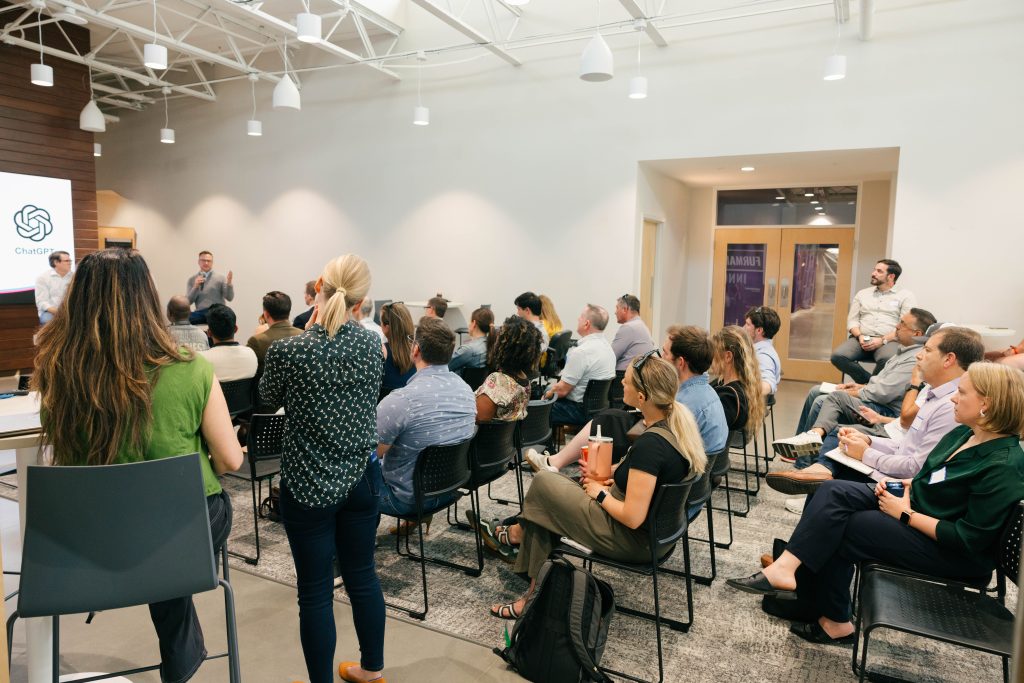

Across the Upstate, there’s a growing sense that marketing is shifting faster than most teams can comfortably keep up with. That’s why we brought in a panel of experts to dig into marketing after AI and how it’s shifting in 2026.
Our panel included Jami Mullikin from Wonder, Michael Catanzaro from The Brand Leader, and Kaleb Alexander with Redhype Creative Marketing Agency (RCMA), and was moderated by Demarcus Jones from Summit Media. These are people running agencies, managing client strategy, and figuring out AI in real time, just like most of us.
The pace isn’t going to slow down. So stop waiting.
Jami kicked things off with something I keep thinking about. AI isn’t making marketing harder, he said. It’s just impatient. It’s compressing timelines and raising the bar for what “fast” means.
He gave a concrete example. Client strategy that used to take him 16 to 20 uninterrupted hours? He’s doing it in three now. He runs his discovery interviews, drops the transcripts in, and the synthesis that used to eat his weekend is done before lunch.
“What used to probably take me an uninterrupted 16 to 20 hours to write a strategy for a client, we’re doing in three hours turnkey.” — Jami Mullikin
Michael does brand strategy and has for 25 years. His firm built a proprietary process, and they’ve now trained their LLM on it. Two-hour focus groups get distilled into structured strategy outputs in minutes, without losing what makes their methodology theirs. Same brain, just a lot faster.
The people getting the most out of this aren’t outsourcing their thinking. They already know what they want. They’re using the tools to get there without the lag.
What stopped working
Kaleb named something I think a lot of us have been feeling. Google search is different now. If you’re not in the AI-generated summary at the top of the page, ranking fourth doesn’t move the needle the way it used to.
The shift is from ranking to being cited. There’s a whole field called generative engine optimization (GEO), essentially SEO for getting referenced inside AI-generated answers. For any business that has relied on organic search traffic, this is worth paying attention to.
The other thing the panel agreed on: generic AI output is getting easier to spot. Michael put it plainly. AI has an accent. You can read it, you can hear it. And as more brands run the same prompts through the same tools, everything starts to sound like everyone else.
“AI has an accent, like a Southern accent. You can read it, you can see it, you can kind of hear it.” — Michael Catanzaro
Kaleb explained why. The training data feeds on itself. Models learn from AI-generated content, which means the same sentence formats keep cycling back. The fix isn’t to stop using AI. It’s to be more specific. Narrative prose, single paragraphs, prompts that break the pattern.
Where quality breaks
Jami was direct about this. AI can’t produce something genuinely novel. It can recombine things that already exist. It can approximate. But the original idea still has to come from a person with taste.
Kaleb brought up MIT research that backed this up in an interesting way. For people who already had subject matter expertise, AI amplified their output. For people who didn’t, cognitive quality declined. The tool is a multiplier. You have to know what good looks like before you can close the gap between what the tool gives you and what you actually need.
This matters a lot if you’re thinking about junior talent. Jami said it plainly: not all humans have taste, and AI definitely doesn’t. The skills you build in those early years of doing the work badly, and then better, are what make you someone who can use these tools well. If you skip that part, the output shows.
“Not all humans have taste. And AI definitely doesn’t.” — Jami Mullikin
Which roles are holding and which aren’t
The panel saw a K-shaped curve forming. Senior roles that require judgment, relationships, and strategy are holding or growing. More executional junior roles are more exposed, and the panel was honest about that rather than dancing around it.
Kaleb pointed out that performance marketing has been getting automated by Google for fifteen years already. What’s happening now is the next wave of the same thing. The roles holding ground are rooted in positioning, strategy, and creative direction. Decisions that require a real call, not just pattern matching.
Michael reframed it in a way that stuck with me: it’s less about which role is safe and more about whether someone is using AI to get better at their job or using it to avoid building the skills the job requires. The former is an asset. The latter catches up with you.
How to start, or how to get organized if you already have
We had a founder in the room during Q&A who raised her hand and said she’s already using AI across her business but doesn’t have a structure for it, and she’s trying to figure out how to think about that as she brings people on. I think a lot of people in the room were nodding.
Jami uses a matrix: high value versus low value, repetitive versus unique. Whatever lands in the low-value, highly repetitive quadrant is where you start. He also shared a sentence frame he uses when working through problems: I want to ____, but ___. The objective and the obstacle. Figure those out before you pick a tool. Most people do it backwards.
Michael’s take: start small, get it working really well, then scale. Build internal muscle first. The companies that will get the most out of it are the ones that understand what they’ve built, not the ones depending on a subscription they don’t fully control.
Kaleb’s version: audit first. Find the actual gaps. See if AI is even the right answer. Sometimes it isn’t. Sometimes the answer is a clearer process or a different hire. Don’t force it.
The question nobody had a clean answer to
Sydney asked something during Q&A that I think about a lot. If companies are cutting entry-level roles because of AI, and the next generation is already using these tools before they’ve built any foundational skills, how do we develop the people who will eventually be senior?
Kaleb pointed out that some categories of work will disappear. It happened in the Industrial Revolution and it’s happening now. New things will come, but the gap in the middle is real.
Michael had the most useful reframe. The people coming out of school right now can build something meaningful with very little. AI compresses the startup curve for solo operators and small teams in a way that didn’t exist five years ago. The smarter question for young people might not be how do I get a job, but what can I build.
The skills that kept coming up across the whole conversation: critical thinking, writing, taste, and the humility to know what you don’t know. None of those are things AI builds for you.