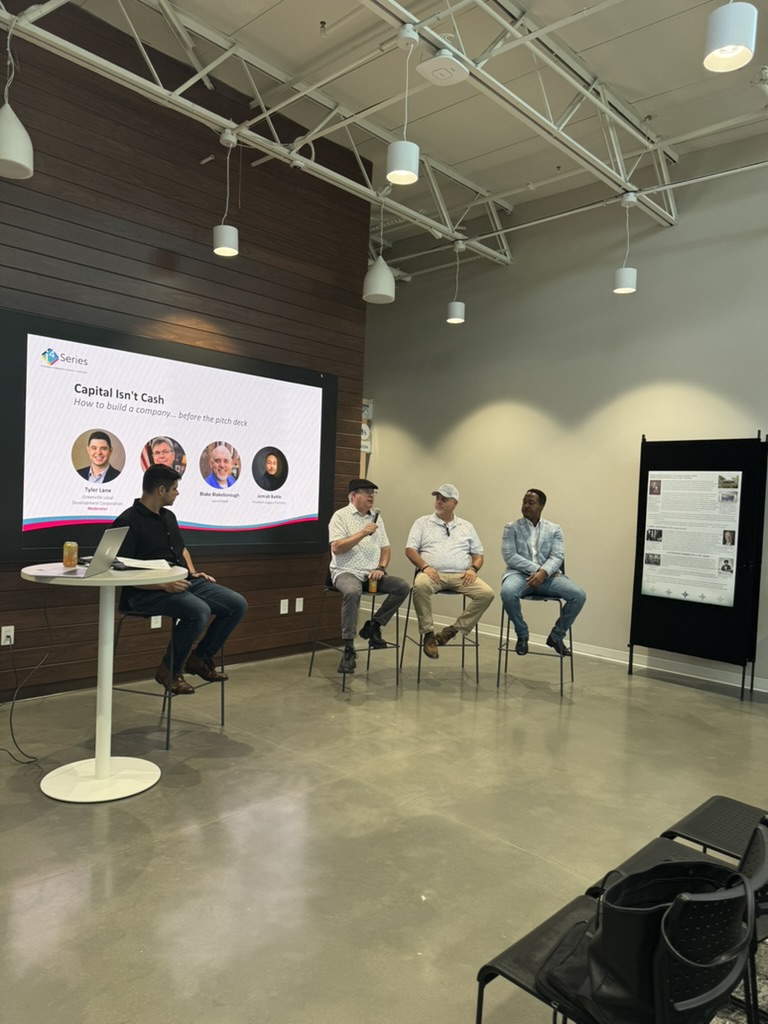
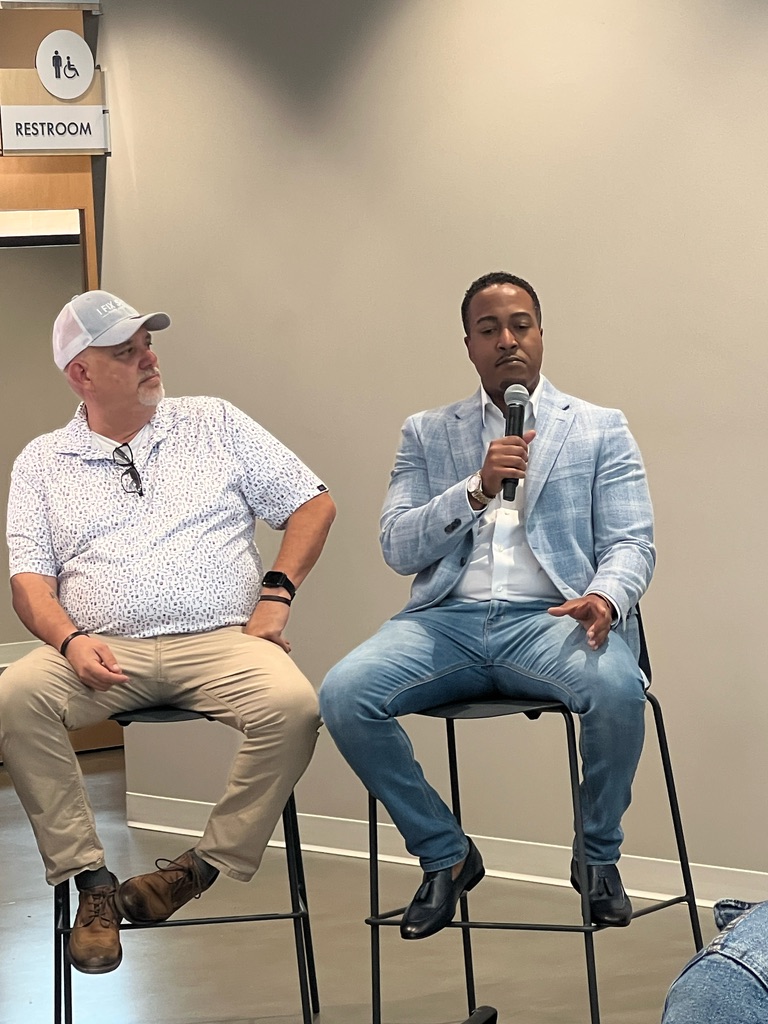

Three funders sat in front of a room of Greenville founders in August and spent the hour explaining why the check is the last thing you should be chasing.
Capital is customers who pay early. It’s grant programs nobody applies to. It’s a vendor who takes equity, and it’s a cap table you didn’t wreck in year one.
Each of the three panelists fund companies at three completely different stages, yet each one opened with a version of the same advice. Not yet.
Tyler Lane of the Greenville Local Development Corporation moderated. The panel was Chris Petrella of SC Forge, Blake Blakeborough of Launchpad Tech Ventures and Jemiah Battle of Proélium Legacy Partners.
Get your customers to fund you
Petrella is a founder who ran South Carolina’s commercialization program inside the Small Business Development Center before spinning it out into a nonprofit in July. SC Forge helps founders statewide commercialize technology, build funding stacks and get to something investable through structured execution.
Asked how he’d go from a napkin idea to a funded company, he told the room not to use fundraising as the way to find out whether you have a business at all.
“You see those montages on TV where the guy says I’m going to invent something, and then there’s a montage, and then the guy’s got a giant house,” he said. That’s not the sequence.
Customers first. Get a client to pay a little extra to be first in line. Get a purchase order you can borrow against. Then work the grant programs, SBIR and STTR especially, which prove the idea holds up and that you can get traction without a check. Build that stack before you look outside.
SC Forge takes five companies per cohort. Seven of the 10 it’s put through are now SCRA member companies with SCRA investment behind them, including Creek Tides Energy & Power, which recently took a $25,000 SCRA grant to advance its patented Reactive Reversible Blade Turbine technology. From February 2025 through August 2026 SC Forge numbers show 15 ventures supported, $4.66 million in grants and capital secured, $626,824 in reported sales, a $9.23 million sales pipeline, 49.5 jobs and 80 intellectual-property milestones.
Petrella was direct about where those numbers come from. “This is not theory. This is not some concept,” he says. Founders do the work. SC Forge tells them which work matters. (Full SC Forge KPI report)
Bootstrap until it costs you something
Blakeborough tells every founder who walks into Launchpad to bootstrap as long as humanly possible. Roughly 80% of his companies do. About 20% go after angel money.
He’s specific about the line where bootstrapping stops being discipline and turns into a tax. “You’re selling an enterprise version to a Michelin or a BMW, the contract is worth $2 million, and it carries functionality milestones on a 60 or 90 day clock that you and your co-founder physically cannot hit alone. That’s when outside money buys you something you can’t build,” he said.
Founders trade away equity, in his opinion, because they have no exchange rate in their head. He described a founder in a recent cohort who came in thrilled about a $200,000 offer. The investor wanted 60% of the company. Launchpad talked him out of it. The rule Blakeborough gives 99% of his founders is don’t sell more than 20% in a pre-seed round. The seed and the Series A are still coming.
His answer to what investors check that founders assume nobody looks at was the best line of the afternoon. The data room. “Checking out a data room is like talking to a teenager. Is your room clean? If they say yes and there’s dirty clothes underneath the bed, the room is not mom clean. It’s teenager clean.”
The person opening that folder is an analyst who sees 100 deals a day and is looking for a reason to stop. Give them one and you’re finished before anyone senior reads a word.
About 100 companies have gone through Launchpad in a little over a year. About 70 of them launched. Thirty-two are now in Ignite, the next step program for founders who are working toward funding. Ignite gives them access to Launchpad’s advisers in go-to-market, finance and tech.
Cohorts start every four months. Founders meet once a week for two hours and do the rest online. The next cohort starts the week of Sept. 22, and you apply at LaunchpadTV.com. Taylor McLemore, a founding partner at Techstars, joined in August to build a virtual cohort, so founders outside Greenville can join too.
The discount is decided in year one
Battle works the far end of the timeline, with companies that already have enterprise value, typically $10 million to $50 million in revenue. Asked which year-one decisions turn into year-10 valuation discounts, he answered fast. Decide who you’d eventually sell the company to and build it to suit that buyer. Start replacing yourself now, so the business can run without you.
Founder dependency gets discounted hardest. Can you leave for 90 days? What happens if the person under you gets hit by a bus? Are there SOPs, are there KPIs anyone is measuring? The skills that make a founder good at the beginning are the same skills that become the bottleneck, and the fix is available on day one and costs nothing. Document the processes. Document the relationships. Document the routine.
He drew a hard line between profitable and valuable. Two companies with identical $3 million profits get different valuations, and the gap sits in what he calls the three predictables: cash flow and profits, transferability, and growth. Underneath those sit the intangibles, which are human capital, structural capital, customer capital, and social capital.
Then he explained why any of this is urgent. Citing Exit Planning Institute data, he said roughly 70% of exits are involuntary, driven by five D’s – death, divorce, disagreement, distress and disability. Of the founders who do exit, about 90% are dissatisfied afterward. Planning early isn’t about selling. It’s about still having options when one of the D’s picks the timing for you.
The money nobody knows exists
Most of the room didn’t know what the GLDC is, so Lane spent part of the hour explaining it. It’s not the county or the city economic development corporation, and it’s not a government agency. It lends money to companies that can’t get the rest of what they need from a bank or an investor. If your deal falls apart without that last piece, the GLDC is the one that could fill it.
The GLDC doesn’t want to be your only funder. It comes in behind the diligence somebody else already did, when the plan is sound and the believers are lined up and then you’re still short. It has written loans from $10,000 to $30,000 on the small end up to $150,000 or $200,000, and it has taken equity stakes and done convertible loans when that made sense.
Geography is the one hard constraint. You need to be in or immediately around the city of Greenville for GLDC. To learn more, reach out to Tyler at tlane@gvldevcorp.com.
What kills deals
An audience member asked what mistakes stop a company cold.
Blakeborough went first and says if you’re building a tech company and raising for it, you need a technical co-founder. You also need to learn the language of fundraising, or you’ll pay for not knowing it. He paid a Greenville firm $15,000 to draw up a SAFE, the standard contract for an early investment, on a $150,000 check. He found out later that Y Combinator, the Silicon Valley accelerator that created the SAFE, publishes that same document for free.
He also thinks founders overvalue holding on. Jack Dorsey owned roughly 2.4% of Twitter by the time Elon Musk bought it, a stake worth about $978 million. Diluted to a sliver of a company he built, and still life-changing.
Petrella kept his shorter. “Google your idea first. Not every idea should be a business, and a lot of founders are answering a question nobody asked,” he said.
He ended with a test for whether a problem is worth solving. Is it a poke or a slap? “If I just sit there and poke you, you’re going to let me poke you all day long. The minute I start slapping you in the face, you want a solution that makes me stop.”
Companies get built on the slap.