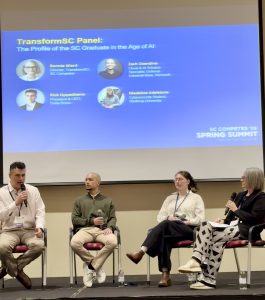
South Carolina’s workforce conversation is shifting quickly, and that shift was on display during the TransformSC panel on the Profile of the SC Graduate in the Age of AI at this year’s SC Competes Spring Summit. Rather than focusing on tools or technology alone, the discussion centered on what employers increasingly expect from students entering the workforce and how education and industry can align around those expectations.
Moderated by TransformSC Director Bunnie Ward, the session brought together perspectives from industry, technology, and higher education to examine how adaptability, communication, and critical thinking are evolving in an AI-driven workplace. The conversation reinforced a consistent theme throughout the summit. While AI is accelerating change, the most important capabilities remain deeply human.
Adaptability as a Baseline Skill
Early in the discussion, panelists returned repeatedly to adaptability as a defining skill for the future workforce. Zach Oxendine of Microsoft described how rapidly changing tools and workflows are already reshaping expectations across technical roles.
He pointed to how quickly developers moved from experimenting with tools like Cursor to integrating ChatGPT into everyday workflows. Many teams are now adapting again and learning how to work with agent-based systems in ways that resemble managing subcontractors on a jobsite.
For students entering the workforce, that pace of change makes adaptability less of a competitive advantage and more of a baseline expectation. Winthrop University cybersecurity student Madeline Adelstone noted that adaptability also strengthens team dynamics by allowing individuals to remain steady contributors during periods of disruption.
Rick Oppedisano of Delta Bravo AI added a broader perspective, arguing that adaptability ultimately begins with clarity about purpose. In a world saturated with information and distraction, he said, understanding what matters most helps professionals filter noise and respond effectively to change.
Communication Still Drives Opportunity
As the conversation shifted toward workplace friction and change management, panelists emphasized that communication and interpersonal skills remain foundational.
Oppedisano framed the issue in practical terms. Business problems, he said, are opportunities, but only if leaders and teams understand them clearly. That begins with listening. “You have to make a connection with someone’s problem,” Oppedisano said. “You’ve got to listen and meet people where they are.”
That insight resonated across the panel. Adelstone pointed to coursework at Winthrop that integrates presentations, writing, and collaborative projects to prepare students for professional communication environments. Oxendine added that clear thinking and clear communication increasingly go hand in hand, especially as AI tools make information easier to verify in real time.
Critical Thinking in a Faster Environment
The panel also explored how critical thinking is evolving alongside AI.
Oxendine described how democratized access to information is raising expectations for preparation and clarity. Leaders now expect teams to arrive at discussions informed, focused, and ready to articulate solutions clearly.
Oppedisano offered a different lens from inside a fast-growing company. At Delta Bravo AI, he said, critical thinking becomes more complex when surrounded by highly capable teams with strong opinions. “Critical thinking gets harder in a room full of smart people,” he said. “You have to be able to quiet the noise.” He also connected critical thinking with emotional intelligence and discipline, noting that focus, self-regulation, and perspective often determine how well individuals process complexity.
Grit, Curiosity, and Hearing “No”
One of the most practical parts of the discussion centered on perseverance and self-direction, especially how young professionals respond to rejection.
Oxendine framed resilience through the lens of curiosity and agency. When faced with resistance, he said, asking why often opens new paths forward. He pointed to recent work organizing a multi-university hackathon as an example of pushing through process barriers with persistence and creativity.
Oppedisano echoed that perspective from an entrepreneurial standpoint. “When I hear no, all I really hear is ‘not like this,’” he said. He described how market shifts once forced his company to rethink its strategy entirely after significant revenue evaporated. For Oppedisano, learning to interpret rejection, whether from individuals or markets, is a critical leadership skill.
Adelstone emphasized that navigating “no” requires combining multiple skills discussed throughout the panel, including adaptability, collaboration, and critical thinking.
Collaboration in an AI-Driven Workplace
The panel also addressed how collaboration is changing as AI reshapes workflows.
Oxendine suggested that organizations will need to rethink traditional assumptions about collaboration, noting that AI is reducing friction across disciplines and making cross-functional work easier than ever. He encouraged leaders to remain open-minded about where ideas come from and emphasized the importance of working across experience levels and backgrounds.
Oppedisano highlighted another dynamic. While AI can accelerate productivity, it can also introduce new tensions inside teams. He described instances where prototyping ideas independently helped communicate concepts more clearly while also requiring strong leadership and communication to avoid misunderstandings.
Adelstone added that strong leadership structures ultimately enable effective collaboration by creating environments where teams feel safe contributing ideas and challenging assumptions.
A Shared Opportunity for South Carolina
As the panel concluded, participants returned to a broader theme. The future workforce will require both technical fluency and human judgment.
When asked to name a defining superpower for future graduates, the panelists’ responses were succinct. Oxendine emphasized independence and urged students not to wait for permission. Adelstone highlighted creativity. Oppedisano encouraged students simply to build something.
Sessions like this reflect a broader shift happening across South Carolina’s business community as organizations move from AI curiosity toward practical adoption. Across industries, leaders appear less focused on predicting the future of work and more focused on preparing students to navigate it with confidence.
Recent Comments