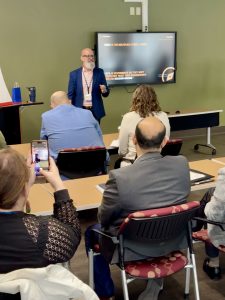
Artificial intelligence was a recurring theme throughout this year’s SC Competes Spring Summit, but the question many leaders are still working through isn’t whether AI matters. It’s where to begin.
During one of the AI sessions, Jason See of Worthwhile offered a practical framework for leaders trying to move from experimentation to measurable business value. Instead of focusing on tools, his talk centered on something many organizations are discovering the hard way: AI adoption starts with readiness.
Why AI Projects Stall
Many companies begin their AI journey with enthusiasm. Leadership announces a new initiative, teams begin testing tools, and pilot projects start to appear across departments. Then reality sets in. Organizations quickly realize the biggest barrier to AI adoption is rarely the technology itself. More often, it’s the underlying data and operational processes that were never designed to support automated decision-making. What begins as an innovation project can suddenly turn into a long-delayed data infrastructure project. At that point, momentum often slows or disappears entirely.
The Data Trust Problem
One of the most telling insights shared during the session focused on a challenge many organizations quietly struggle with: trusting their own data. “Trust is the multiplier,” See explained. “About 67% of organizations say they don’t fully trust the data they use to make decisions. If you don’t trust your data, AI doesn’t solve the problem. It amplifies it.”
He illustrated the point with a simple client example. When he asked how many data sources the company relied on, the answer was five. When he asked how many they actually trusted, the answer was none. Instead of attempting to fix everything at once, See recommended starting with a single trusted source of truth tied to an important business decision. Building confidence in one reliable data pipeline can create the foundation for broader AI adoption.
AI Changes the Model, Not the Menu
One of the most memorable concepts from the session was a simple distinction between what businesses sell and how they operate. “AI changes the model, not the menu,” See said. “Most businesses won’t change what they sell. What AI changes is how organizations learn, make decisions, and deliver their products or services.” That distinction matters because many organizations attempt to layer AI on top of existing workflows rather than rethink how work actually happens. Real transformation often requires redesigning processes instead of simply adding new software tools.
A Practical Framework for Adoption
To move beyond experimentation, the session outlined a practical framework built around three components: readiness, use cases, and guardrails.
- Readiness – Before launching AI initiatives, organizations need to assess whether their data, workflows, and teams are prepared to support AI-driven decision making.
- Use cases – Rather than attempting to transform an entire organization at once, leaders should focus on a single problem where AI can deliver measurable value.
- Guardrails – As teams experiment with AI tools, organizations need lightweight governance that allows innovation while protecting sensitive information.
“AI moves fast, but people adopt change more slowly,” See noted. “Guardrails allow teams to experiment safely without creating unnecessary risk.”
The Human Side of AI
Technology adoption is rarely just about technology. Culture, leadership alignment, and employee confidence often determine whether new tools succeed or fail. Successful organizations approach AI adoption as both a technical and human transformation. Teams need clarity about how tools should be used, where human oversight remains essential, and how experimentation fits into the broader strategy. When employees understand the purpose behind AI initiatives, adoption tends to follow naturally.
Where to Start
For leaders trying to determine their next step, the guidance from the session was intentionally simple. Choose one meaningful use case, define a clear success metric, and run a controlled experiment with the right guardrails in place. Small wins create momentum. Momentum builds confidence. Over time, those incremental experiments can evolve into broader transformation.
Sessions like this reflect a broader shift happening across South Carolina’s business community as organizations move from AI curiosity toward practical adoption. The companies seeing the most success are not the ones chasing every new tool. They are the ones taking the time to build the operational readiness needed to make AI work.
Recent Comments